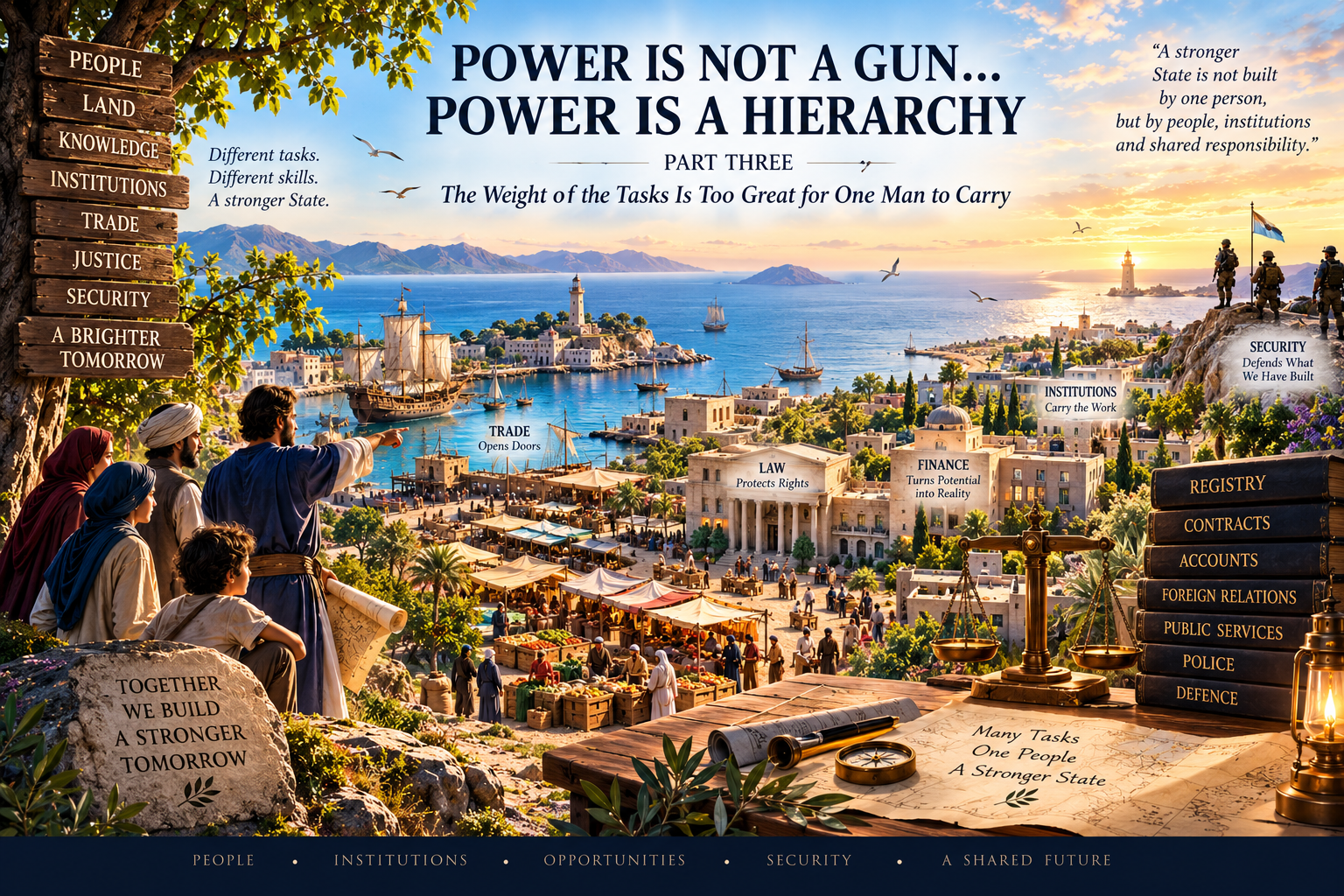
“Their land had not grown much larger. Life upon it had.”
A story about the moment a community discovers that power is not one office, one voice, or one weapon — but the capacity to carry many responsibilities at once.
Months had passed since the drought ended.
The rains had returned. The well was full again. Green had spread across the fields. But the drought had left its marks.
Some farmers had lost their seed. Livestock had died. Tools were worn. Medicines were running low. Then, one morning, something appeared on the horizon.
Waad was the first to see it.
He stared for a moment, then ran towards the settlement.
“A ship!”
People hurried to the shore.
It was not the old vessel that had carried them to this land and then died upon its sands. This ship was moving.
And it was coming towards them.
FROM BEYOND THE SEA
The strangers were traders.
They opened their crates before the gathering crowd.
Iron tools.
Cloth.
Seeds.
Medicines.
One of the men who looked after the wells picked up a metal tool and turned it in his hands. “With this, we could dig deeper.”
A farmer bent over a sack of seed.
“And these?”
“They survive dry ground better than yours,” the trader replied.
Waad looked into the open crates.
“Do you have more things like these?”
The trader laughed.
“Where we come from, there is more than one ship could carry.”
Qadir stepped forward.
“Then we will buy what we need.”
The trader looked at him.
“With what?”
Qadir paused.
PART THREE • THE WEIGHT OF THE TASKS IS TOO GREAT FOR ONE MAN TO CARRY | 2 POWER IS NOT A GUN… POWER IS A HIERARCHY | PART THREE
Then he pointed towards the market.
“Come and see what we have.”
And the trader followed him.
The visitors stayed for several days.
They bought produce and goods from the settlement and sold tools, seeds and medicines in return. Before leaving, their leader asked to speak with Amin.
“We will come again,” he said, “if we can settle a few things before the next voyage.” “Such as?”
“What we should bring. What we can buy from you. Where our ships may dock. And who we speak to when a decision is needed.”
Qadir answered immediately.
“You speak to Amin.”
The trader looked at Amin.
“And if he is not here?”
“He will be.”
The man smiled.
“The sea is too wide to cross on the word will.”
Then he left.
That evening, Qadir said:
“Next time, go with them.”
Amin looked at him.
“Where?”
“To their country. Make the arrangements there.”
Hur laughed.
“And what happens here while Amin is at sea?”
“We manage until he returns.”
“Excellent. Amin travels and Qadir rules.”
The others laughed.
“That is not what I said,” Qadir protested.
Waad had been listening.
“Why does Amin have to go at all?”
Everyone turned towards him.
“Someone else could go.”
Qadir nodded.
PART THREE • THE WEIGHT OF THE TASKS IS TOO GREAT FOR ONE MAN TO CARRY | 3 POWER IS NOT A GUN… POWER IS A HIERARCHY | PART THREE
“Problem solved.”
Ahd shook her head.
“Problem begun.”
Qadir frowned.
“What now?”
“If they ask this person for something, what may he agree to?”
“Whatever we have agreed.”
“And if they ask for something we have not discussed?”
Qadir said nothing.
Ahd continued.
“Can he give them permanent land on the coast? Promise next year’s harvest? Allow their ships to enter whenever they wish?”
Amin looked around the group.
“Whoever goes in our name must know what we want, what we can offer, and what he has no authority to promise.”
Waad looked at him.
“So he does not go in his own name.”
“No, Waad.”
Amin paused.
“He goes in ours.”
“HOW DO I KNOW THIS LAND IS YOURS?”
The arrival of the ship awakened the market.
People wanted more tools and seed.
The traders wanted more produce.
One farmer approached a trader.
“Give me the tools and seed now. I will pay you after the harvest.”
“And what guarantees that you will?”
The farmer pointed towards his fields.
“My land.”
The trader looked across them.
“How do I know it is yours?”
Qadir laughed.
“We all know it is his.”
“You know. I do not.”
PART THREE • THE WEIGHT OF THE TASKS IS TOO GREAT FOR ONE MAN TO CARRY | 4 POWER IS NOT A GUN… POWER IS A HIERARCHY | PART THREE
The trader pointed towards the neighbouring field.
“And that one?”
“Mine,” said one man.
“Not all of it,” another said at exactly the same moment. The first man spun around.
“What do you mean?”
“The land beyond the tree is mine.”
“The boundary is the rock.”
“It has never been the rock.”
Their voices rose.
The trader looked at Qadir.
“I thought you all knew.”
Qadir said nothing.
Mizan stepped forward.
“Who witnessed the boundary?”
The two men gave him two names.
“One died last year,” someone said.
“And the other?”
“Left years ago.”
Waad looked from one man to the other.
“What happens when everyone who remembers is gone?” No one answered.
The following morning, Mizan went out with people who knew the land. They walked the boundaries.
They listened to witnesses.
They measured.
And they wrote.
The owner’s name.
Where the land began.
Where it ended.
How it had come into his possession.
A tree and a rock were no longer enough to carry a man’s rights.
PART THREE • THE WEIGHT OF THE TASKS IS TOO GREAT FOR ONE MAN TO CARRY | 5 POWER IS NOT A GUN… POWER IS A HIERARCHY | PART THREE
WAAD SAYS IT AGAIN
Weeks later, a trader returned angry.
“I want the twenty sacks you promised me.” The farmer stared at him.
“Ten.”
“Twenty.”
“I never said twenty.”
Qadir stepped between them.
“Who was there when you agreed?”
Both men gave the same answer.
“No one.”
Qadir threw up his hands.
“Then how are we supposed to know?”
Waad was standing beside Mizan.
“Write it down.”
Amin turned towards him and laughed.
“You have said that before.”
Waad shrugged.
“It seems I may have to keep saying it.”
The crowd laughed.
After that, important agreements began to be written. Months later, a man arrived carrying half a sheet of paper. “This is my agreement.”
Mizan examined it.
“Where is the rest?”
“If I knew that, I would not be standing here.” Ahd looked at the torn page.
“Then writing it is not enough.”
Waad pointed towards the land records.
“Keep another copy here.”
“With those?” Mizan asked.
Waad looked at the growing pile of papers.
“I think the papers are going to need a home.”
PART THREE • THE WEIGHT OF THE TASKS IS TOO GREAT FOR ONE MAN TO CARRY | 6 POWER IS NOT A GUN… POWER IS A HIERARCHY | PART THREE
MONEY IN A BOX
Not everyone who could work had the money to begin.
One farmer approached a man who had accumulated savings through trade.
“Lend me enough to buy seed. I will repay you after the harvest.”
“And if the harvest fails?”
“The following season.”
“And if that fails too?”
The farmer hesitated.
“So I leave my field empty because you are afraid, while your money stays in a box because you are afraid?”
The man did not like the answer.
But he had no quick reply.
Waad had overheard them.
That evening, he spoke to Amin.
“One man has money he is not using.”
“Yes.”
“The other has land he can farm, but no money.”
“Yes.”
Waad thought for a moment.
“So the money is waiting in a box… and the land is waiting for the money.”
In the days that followed, people who understood figures began sitting with farmers and those willing to lend. They recorded the amount.
The date of repayment.
The security.
The terms agreed between them.
Soon, some people began leaving part of their savings in one secure place instead of hiding them in their homes.
The records grew.
Money began to move.
And the fields began to grow with it.
ONE MORNING IN AMIN’S OFFICE
One morning, Amin found a long queue waiting for him.
“My neighbour moved the marker on my land,” said the first man.
PART THREE • THE WEIGHT OF THE TASKS IS TOO GREAT FOR ONE MAN TO CARRY | 7 POWER IS NOT A GUN… POWER IS A HIERARCHY | PART THREE
“I need an agreement recorded before a trader returns next month,” said another. “If I cannot get money this week,” said a farmer, “I will miss the planting season.” Then came one of the well workers.
“The part we need cannot be made here.”
A messenger arrived carrying a letter from across the sea.
Then another man burst through the door.
“Someone stole my goat!”
Amin raised his hand.
“One at a time.”
An hour passed.
Then another.
The queue remained.
Qadir sat in the corner watching.
“You need to decide faster.”
Amin looked up.
“Help me.”
“How?”
Amin pushed the land dispute towards him.
“Decide this.”
Qadir read it.
“I don’t know where the old boundary was.”
Amin handed him the loan figures.
“This?”
Qadir stared at the numbers.
“Give it to someone who understands accounts.”
Amin handed him the traders’ letter.
Qadir read the first two lines and handed it back.
“I don’t know what we told them last time.”
Amin smiled.
“And I cannot be at the well, in the market, on every farm and aboard a ship at the same time.” He looked at the papers.
Then at the line outside his door.
“The problem is not that there is too much work.”
Qadir waited.
PART THREE • THE WEIGHT OF THE TASKS IS TOO GREAT FOR ONE MAN TO CARRY | 8 POWER IS NOT A GUN… POWER IS A HIERARCHY | PART THREE
Amin continued.
“The problem is that it is not one kind of work.”
He touched the land papers.
“This needs one kind of knowledge.”
Then the accounts.
“This needs another.”
He pointed towards the well.
“Water has its own people.”
Then he lifted the letter from across the sea.
“And whoever deals with those beyond our shores must know what is happening here and what we have agreed there.”
Qadir folded his arms.
“So what do we do?”
Amin looked again at the waiting crowd.
“The weight of the tasks has become too great for one man to carry.” Waad asked:
“Then we need more Amins?”
Ahd shook her head.
“We do not need more rulers.”
She looked at the papers.
“We need people who know their work.”
DIVIDING THE WORK
They began to divide the tasks.
Those who understood land and records dealt with land.
Those who understood accounts and transactions dealt with money.
Those who understood the settlement’s needs and its dealings with others kept contact with those beyond the sea.
Those who knew water continued to manage water.
Qadir said:
“We should choose the most trustworthy.”
“Trustworthiness is where we begin,” Ahd replied.
“What else do you want?”
She handed him the accounts book.
PART THREE • THE WEIGHT OF THE TASKS IS TOO GREAT FOR ONE MAN TO CARRY | 9 POWER IS NOT A GUN… POWER IS A HIERARCHY | PART THREE
“Manage this.”
Qadir looked at the columns of figures.
Then laughed.
“Fine. Point taken.”
Waad smiled.
“So we need people we trust who also know what they are doing.”
“Exactly,” said Ahd.
Waad thought again.
“And if someone knows more than the rest of us, does that mean he can do whatever he wants?” “No,” said Mizan.
“Why?”
Amin answered.
“Because we gave him a task, not the whole State.”
Qadir looked at him.
“But you are giving each of them some of your authority.”
Amin shook his head.
“We are not dividing the State, Qadir. We are dividing the work.” Time passed.
Some of the people changed.
The records remained.
Others took over their duties.
The work continued.
Not everything had to wait for Amin’s door to open in the morning.
THE BROKEN DOOR
Then, one morning, a trader found the door to his storehouse smashed open. Goods were missing.
Qadir arrived furious.
“I know who did it.”
Mizan looked at him.
“Did you see him?”
“He was hanging around the storehouse yesterday.”
“That is all?”
“We search his house. If we find the goods, that settles it.”
PART THREE • THE WEIGHT OF THE TASKS IS TOO GREAT FOR ONE MAN TO CARRY | 10 POWER IS NOT A GUN… POWER IS A HIERARCHY | PART THREE
Hur looked at him.
“And who searches your house tomorrow when someone accuses you?”
Qadir frowned.
“I do not steal.”
“He will say the same.”
The trader shouted:
“While you argue, he could be selling my goods!”
“Exactly,” said Qadir. “We go now.”
Hur stepped closer.
“Today you enter one man’s home because you suspect him. Tomorrow ten men enter ten homes, each saying he is looking for what belongs to him.”
Qadir fell silent.
Amin spoke.
“We need people whose job this is.”
The trader looked at him.
“What job?”
“To protect people. Find out what happened. Gather the evidence.”
Mizan added:
“But not decide the punishment.”
Waad looked at him.
“Why not?”
“Because the person searching for the truth should not also decide, alone, what happens to the accused.” Qadir asked:
“And if the man runs?”
“Then they must have enough power to do their job,” Amin replied.
Hur added quietly:
“And no more than they need.”
In time, people knew whom to call when a crime was committed.
They called them:
the police.
THE SHIP THAT DID NOT COME TO BUY
The harbour grew.
More ships arrived.
PART THREE • THE WEIGHT OF THE TASKS IS TOO GREAT FOR ONE MAN TO CARRY | 11 POWER IS NOT A GUN… POWER IS A HIERARCHY | PART THREE
Waad learned to recognise the traders’ vessels by their markings before they reached the shore. Then, one morning, he saw a ship he did not recognise.
It did not stop where the others stopped.
It did not wait to be guided into the harbour.
It kept coming.
Qadir joined Waad on the shore.
He stared at the vessel.
“Go and get Amin.”
“Why?”
“Go.”
Soon they could see armed men on deck.
A boat came ashore.
Several men stepped onto the sand.
“We want provisions and goods,” one of them said.
A market trader answered:
“We can sell you what you need.”
The stranger laughed.
“I did not say we came to buy.”
He looked towards the storehouses.
“Give us what we want and no one gets hurt.”
Someone behind Amin said:
“Let us talk to them.”
Qadir looked at him.
“Talk. But words alone will not stop a man who has come to take by force.” Amin watched the armed men.
“We speak first.”
Qadir nodded.
“And if they will not listen?”
Amin’s eyes remained on the shore.
“Then we defend our land.”
Men came forward asking for weapons.
“Give them out,” Qadir said.
Hur stopped him.
“To everyone who asks?”
PART THREE • THE WEIGHT OF THE TASKS IS TOO GREAT FOR ONE MAN TO CARRY | 12 POWER IS NOT A GUN… POWER IS A HIERARCHY | PART THREE
“We need men.”
“We also need to know who commands them.”
“I do.”
“And when may they use their weapons?”
“When we are attacked.”
“And if the attackers retreat?”
“We stop.”
“And if one of them drops his weapon?”
Qadir sighed.
“Hur, the fight has not even started.”
“That is why I am asking now.”
Qadir stared at him.
Then answered:
“If he lays down his weapon, we do not kill him.”
Hur nodded.
“Good.”
“Finished?”
“Now I am.”
Amin almost smiled.
“Qadir leads the defence. No one acts alone. Our task is to protect the people and the land.” No one objected.
The confrontation did not last long.
The raiders had expected an exposed shore and unguarded storehouses. Instead, they found people organised and ready to defend them.
After a short clash, the raiders withdrew to their boat.
Their ship moved back towards the horizon.
Qadir remained on the shore, weapon in hand.
Waad came to stand beside him.
“You see?”
“See what?”
Qadir lifted the weapon slightly.
“This.”
Waad looked at the gun.
Then he turned around.
PART THREE • THE WEIGHT OF THE TASKS IS TOO GREAT FOR ONE MAN TO CARRY | 13 POWER IS NOT A GUN… POWER IS A HIERARCHY | PART THREE
Behind them were the farms.
The well.
The school.
The market.
The storehouses.
The homes.
And the harbour that now connected them to a world they had once known nothing about. Waad looked back at Qadir.
“Yes. But what would your gun have had to protect if we had never built any of this?” Qadir looked behind him.
Then back at the sea.
“And without the gun, they might have taken all of it.”
Amin had walked up behind them.
He looked at Qadir.
“You are right.”
Waad turned towards him.
Amin continued:
“A State needs strength to protect what it has built.”
Then he looked at the weapon in Qadir’s hand.
“But the gun protects what we built. It did not build it.”
This time, Qadir did not disagree.
WHEN THE STATE BECAME POWERFUL The raiders disappeared beyond the horizon.
People returned to their lives.
But Hur remained watching the armed defenders.
“The danger is gone.”
“Yes,” said Qadir.
“And the weapons?”
“What about them?”
Hur pointed towards the settlement.
“We now have people who can stop someone when a crime is committed.” Then towards the defenders.
“And people who carry weapons in our name.”
PART THREE • THE WEIGHT OF THE TASKS IS TOO GREAT FOR ONE MAN TO CARRY | 14 POWER IS NOT A GUN… POWER IS A HIERARCHY | PART THREE
Waad joined in.
“And people who keep the land records.”
Mizan said:
“And the agreements.”
Ahd added:
“And the money.”
Amin looked towards the sea.
“And people who speak in our name beyond our shores.”
Waad was quiet for a moment.
“Each of them now has something they did not have before.”
Amin asked:
“What?”
Waad looked at him.
“Power.”
No one spoke.
Waad looked towards the defenders.
Then Qadir.
Then Amin.
“And if one of them uses that power where it does not belong… who stops them?” Qadir answered:
“Amin.”
Waad turned towards Amin.
But Ahd spoke first.
Quietly.
“And if Amin is the one who crosses the line?”
No one answered.
The sea was calm again.
The raiders were gone.
But the police remained.
The records remained.
The money remained.
Those who spoke for them abroad remained.
And the armed force remained.
PART THREE • THE WEIGHT OF THE TASKS IS TOO GREAT FOR ONE MAN TO CARRY | 15 POWER IS NOT A GUN… POWER IS A HIERARCHY | PART THREE
The State that had begun with a group of survivors trying to live together could now carry burdens no single person could carry.
But they had discovered something else.
The greater the State’s power to act, the more important the question of what should restrain that power. They had learned how to build power.
Now they had to answer a harder question:
Who governs power itself?
And the people of the ship were about to discover that even the greatest power needs a rein.
PART FOUR: THE REIN OF POWER
The story continues: power has been built. The next question is how power itself is restrained.