“I do not only want to know what this agreement will give us today. I want to know what it will make us tomorrow.”
Waad’s last question had been simple:
“If the eyes can see the truth… who knows what we should do with it?”
Ahd had not answered him then.
A few weeks later, the answer came from the sea.
A ship larger than the usual trading vessels entered the harbour. It carried a delegation from a country that had traded with them for years.
Their leader unfolded a map before Amin.
“We would like to build you a port.”
“We already have one.”
The man smiled. “You have a harbour. We are offering you a port large enough for major ships.”
New docks. Warehouses. A road connecting the port to the market. Jobs. More trade.
Qadir asked, “And who pays for all this?”
“We do.”
Qadir looked at Amin. His face said it for him: Say yes.
The Offer
As soon as the delegation left, Qadir turned to Amin.
“What are you waiting for? They build the port with their money. Our people get jobs. Our trade grows. What exactly is left to think about?”
Waad asked, “What do they want?”
“To trade with us.”
“Only that?”
Qadir paused.
Ahd had been listening. “That is a question worth asking.”
The delegation returned the following day.
Amin spoke first. “Before we discuss what you are offering us, I want to understand what you want from us.”
“We want the right to operate part of the port for thirty years.”
“What else?”
“Priority for some of our ships. And land for storing our goods.”
“Why our port?”
The man traced a shipping route with his finger. “Because your coastline shortens our journey to other markets by several days.”
Amin looked at the map again. This time he did not simply see a coastline.
He saw its position.
The Question That Changed the Offer
After the delegation left, Waad said, “So they need us too.”
Qadir shrugged. “And we need them. What is wrong with that?”
“Nothing,” Amin said.
Then he pointed at the map.
“But before I can understand the value of what they are offering us, I need to understand the value of what we are offering them.”
“Land?” Qadir asked.
“Perhaps more than we realise.”
Amin looked again at the route on the map.
“Why did they choose us?”
No one answered immediately.
And that was where the real thinking began.
The Filter
Information started arriving.
One trader said, “Their country is extremely wealthy.”
Another said, “I heard they built a port somewhere else and ended up controlling that country’s trade.”
A third disagreed. “Nonsense. That port helped the country prosper.”
Reports arrived about the commercial value of the shipping route.
Qadir shook his head. “The more we ask, the less we seem to know.”
Waad laughed. “Then how are we supposed to decide?”
Ahd picked up one piece of paper. “This is a rumour.”
Another. “This needs verification.”
Then a third. “This is supported by more than one reliable source.”
“So the mind filters what reaches it?” Waad asked.
“Yes. But it does not throw away what it dislikes.”
“What does it do?”
“It tries to make the truth clearer.”
When Truth Alone Is Not Enough
After checking the information, much of what the delegation had said proved to be true.
They would build the port. Trade would increase. Jobs would be created.
Qadir smiled. “Good. Now we are finished.”
“Not yet,” said Ahd.
“What now? They told us the truth.”
“Yes. But why are they prepared to spend so much money?”
“For profit.”
“How much?”
Qadir did not know.
“Why thirty years? Why this particular stretch of coast?”
Again, no answer.
Waad frowned. “But they did not lie to us.”
Ahd nodded.
“True. But the truth does not always end with the last words someone says to you.”
Then she added:
“Sometimes the most important part of what you hear is the question you have not yet asked.”
Price and Value
Those responsible for finance came to Amin.
“The amount they are offering is substantial.”
Amin asked, “And what is the value of what they will receive?”
“The land?”
“The land,” said Amin. Then he pointed at the map. “The location.” Then at the proposed term. “Thirty years.”
He looked back at them.
“You have told me the price. I am asking about the value.”
From that moment, the conversation changed.
More Than One Truth
The people with relevant knowledge were brought together.
Those concerned with the economy said, “The project will increase trade and income.”
Those responsible for land said, “Families and fishermen already depend on that part of the coast.”
Those familiar with foreign relations said, “It may open new markets, but it could also affect other relationships.”
Those responsible for security said, “A major port is strategically important. We need to know who controls access and operations.”
Waad listened. “You are all saying different things.”
Mizan replied, “Because each of us is looking from a different angle.”
“Then who is right?”
Mizan smiled.
“Perhaps all of us. The same truth can have different consequences for different parts of the State.”
Consultation
Amin looked around the room.
“I do not want you to make the decision. I want the options.”
They worked through them: accept the offer, reject it, or accept it on different terms.
One expert favoured acceptance. Another wanted renegotiation. A third thought rejection was safer.
Waad looked at Ahd. “Even the experts disagree.”
“That is why it is called consultation, not decision.”
“Then what is consultation for?”
“To show the decision-maker the roads available to him — and what may be waiting along each one.”
The Balance
Amin sat with the options before him.
“What do we gain? What do we give? What might we lose if we reject it? What might we lose if we accept it?”
Finally, he asked:
“What will our State look like when this agreement ends?”
Qadir looked at him. “What do you mean?”
“After thirty years, will we simply have a port? Or will we also have people who know how to run it?”
He asked about training, knowledge, technical skills, and whether their own people would eventually be able to operate and maintain the port without outside dependence.
Then he said:
“I do not only want to know what this agreement will give us today. I want to know what it will make us tomorrow.”
Waad turned to Ahd. “So the mind of the State is like a balance?”
“In part.”
“What goes on one side?”
“What we gain.”
“And on the other?”
“What we give, what we may lose, and the risks we agree to carry.”
“What if they benefit more than we do?”
“That is not the only question. They may benefit greatly, and so may we.”
“Then what matters?”
“Whether what we gain is worth what we give and the risks we take.”
Then she added:
“A good agreement can serve both sides. But a State must know the value of what it owns before it sits at the negotiating table.”
Assessing the Situation
Qadir was growing impatient.
“We have the information. We have the experts. We have the options. Why don’t we decide?”
“Because I have not yet completed my assessment of the situation,” Amin replied.
“Didn’t the experts do that?” Waad asked.
“Each gave me what he could see from where he stood.”
Amin placed his hand on the papers before him.
“My responsibility is to see the whole picture.”
Ahd said:
“An expert sees deeply within a field. A decision-maker must see broadly across fields.”
Amin continued reading. Comparing. Questioning. Weighing.
Then he formed his assessment.
And made his decision.
Neither Yes… Nor No
Amin met the delegation again.
“Have you accepted our offer?” their leader asked.
“We want the port,” Amin replied.
The man smiled.
“But not on these terms.”
They proposed a shorter period, regular reviews, training for their own people, transfer of the knowledge needed to operate the port, and protection for those who already depended on the coast.
The delegation leader read the proposals.
“You are asking for a great deal.”
Amin smiled.
“So are you. That is why we are negotiating.”
The negotiations continued. Both sides gave ground on some points and held firm on others.
Eventually, they reached an agreement in which each could see a benefit.
The Falcon’s Mind
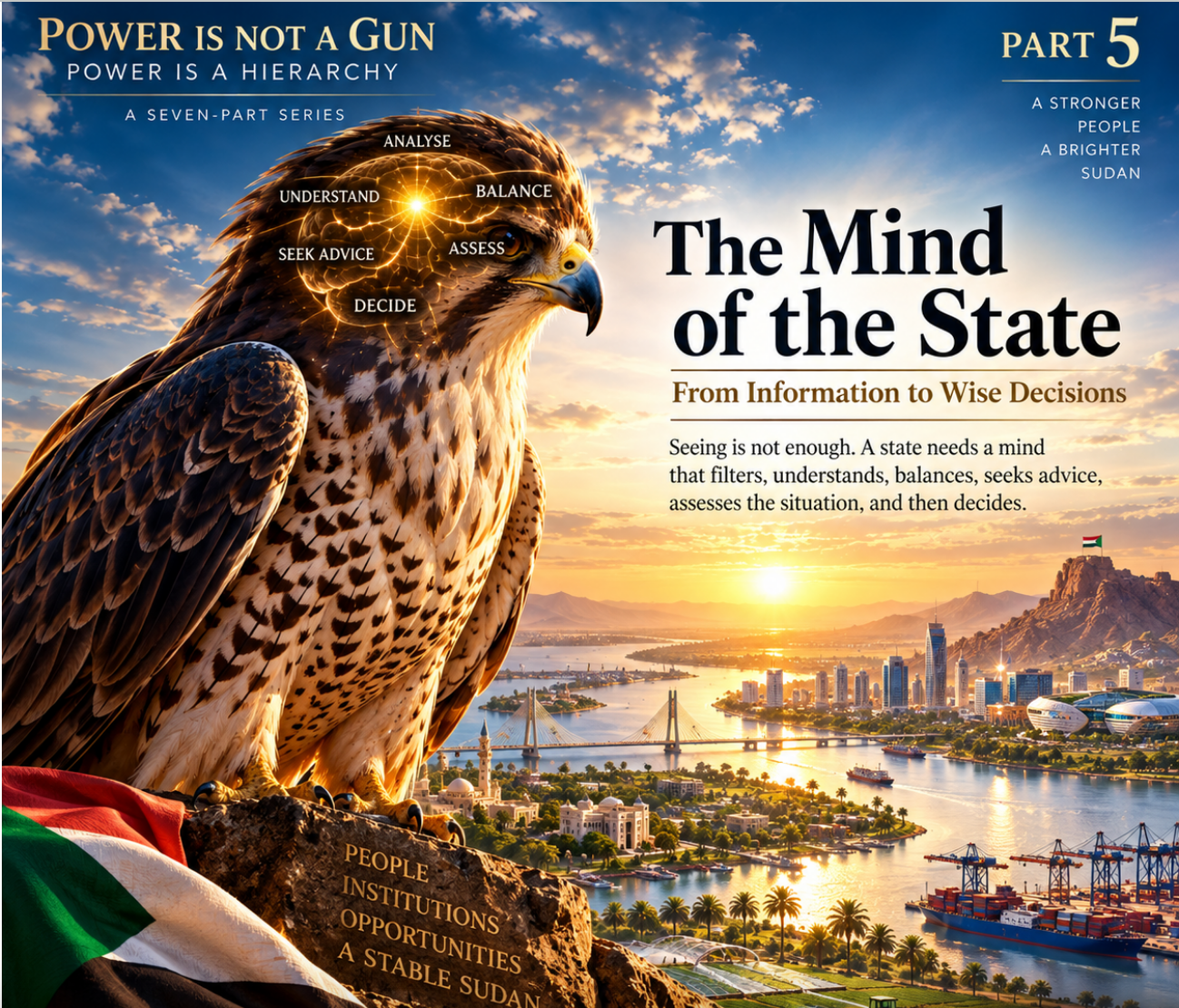
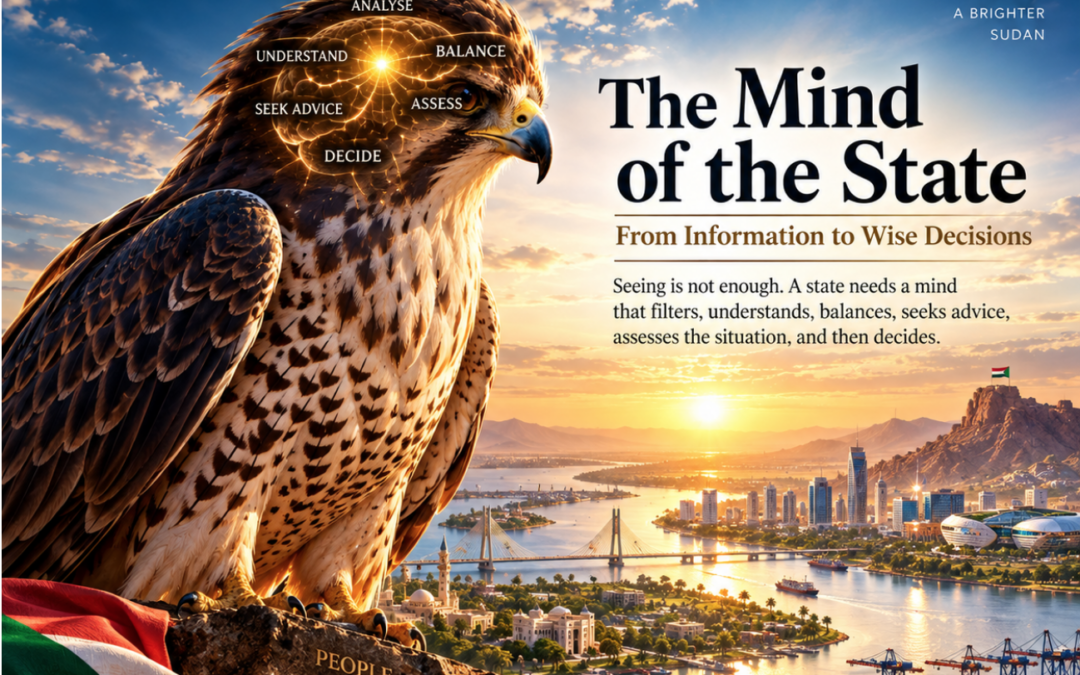
That evening, Waad watched the Sudanese Falcon.
“I understand its eyes now.”
“What do they do?” Ahd asked.
“They see the truth.”
Then he pointed towards the falcon’s head. “And the mind?”
“It does not swallow everything that reaches it.”
“What does it do?”
“It filters.”
“And then?”
“It reads.”
“Then?”
“It analyses and weighs.”
Waad nodded. “And then it decides?”
“No.”
Ahd continued:
“People with knowledge provide advice and options. But the decision belongs to whoever the Constitution and the law have given the authority to make it.”
“Amin?”
“In this case, yes.”
“Why him?”
“Because the whole picture comes before him — and because he carries responsibility for the decision.”
“Does he have to know more than all the experts?”
Ahd smiled.
“No. The expert knows more within his field. The decision-maker must know how to bring those different fields together into one picture.”
Where Does the Mind of the State Come From?
Waad looked towards the people who had spent days examining the proposal.
“Where does a State find all these people who know?”
Ahd pointed towards the school, then towards the books, then towards the people whose knowledge and experience had informed the discussion.
“The mind of the State is not born on the day the State needs it.”
“When is it born?”
“It is built over years — through education, research, experience and expertise.”
Then she said:
“A State that neglects knowledge today may one day face a decision greater than the knowledge it possesses.”
Waad looked again at the falcon.
“So the eyes see.”
“Yes.”
“The mind filters, reads and weighs.”
“Yes.”
“Consultation provides the options.”
“Yes.”
“And the person with lawful authority assesses the situation and makes the decision.”
Ahd nodded.
“And carries responsibility for it.”
The falcon remained in the sky for a while. Then it began to descend.
Its wings opened wide as it approached the ground. Its legs reached down.
It landed. Firmly.
Ahd watched it for a moment.
Then asked:
“And what use is it for the falcon to see clearly, think wisely and fly powerfully… if it cannot find a stable environment in which to stand firm?”
Waad looked at the falcon’s legs.
“A stable environment?”
Ahd nodded.
“Even the strongest falcon needs somewhere safe and stable to stand.”
And that was another question.
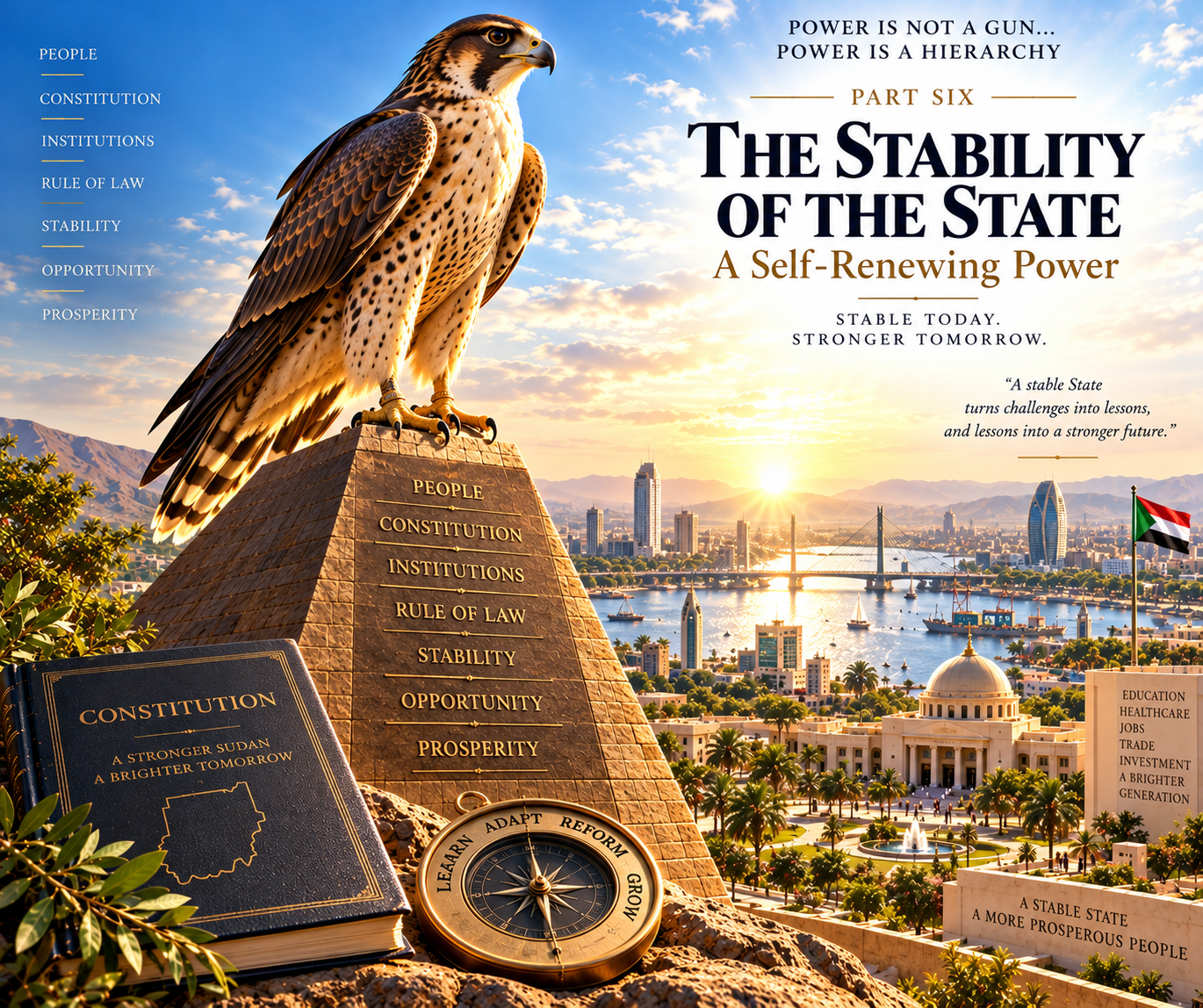
PART SIX IS COMMING SOON: “THE STABILITY OF THE STATE”