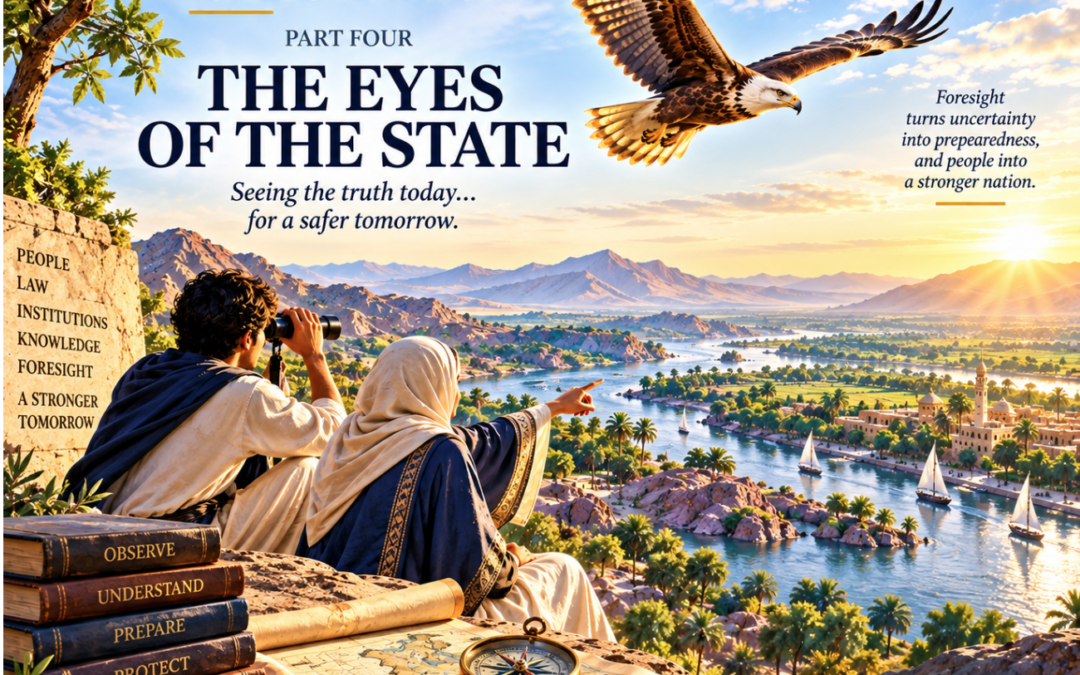
“Foresight sees before strength is forced to confront.”
Years had passed since the first ship came to rest on their shore.
The community had grown. Trade had expanded. There were now people responsible for land records, agreements, money and security.
One morning, Qadir stood looking across the harbour.
“We are strong now.”
Waad looked at him.
“How do you know?”
“We have what we need. And we have people who can protect us.”
Waad thought for a moment.
“Is strength only about being able to face danger when it arrives?”
Qadir looked at him.
“What more do you want?”
Waad had no answer.
Not yet.
Something in the Water
A few days later, a man arrived from upstream.
He went to the people responsible for the water.
“The river has changed,” he said. “It is more clouded than usual.”
“Perhaps it rained somewhere upstream.”
“Perhaps.”
He left.
Several days later, a fisherman arrived carrying two dead fish.
“We found many like these this morning.”
Qadir looked at them.
“Fish have died before.”
“Yes. But I have never seen so many.”
Qadir shrugged.
“Tell us when you know why.”
A week later, a message arrived from further upstream.
Part of a mountainside had collapsed, sending rock and earth into the river.
Qadir nodded.
“There is our answer.”
But one of the water specialists opened a map.
“Perhaps part of it.”
“What do you mean?”
“The rocks may have blocked part of the river. If enough water gathers behind them, they could form a natural dam.”
“And perhaps nothing happens.”
“True.”
Waad had been listening.
“Could the dam collapse?”
“It could.”
“Will it?”
“I don’t know.”
“Is it likely?”
The man hesitated.
“I don’t think so.”
Qadir smiled.
“Then there is our answer.”
Waad looked down at the map. Then asked:
“And if it does?”
The Other Question
The water specialists studied the river and the lower ground. Then they placed a map before Amin.
“The barrier may never collapse,” one of them said. “But if it fails suddenly, a large volume of water could move through these areas.”
His finger travelled across the map.
Fields. Storehouses. Homes. Part of the old market.
Waad stared at it.
“We were asking the wrong question.”
Amin looked at him.
“What should we have asked?”
“It was not enough to ask: Will it happen?”
Waad pointed to the low-lying land.
“We should also have asked: What happens to us if it does?”
When Small Things Become a Picture
Amin asked for more information. The river level was monitored. Fishermen reported what they had seen. Farmers brought their observations. News arrived from ships that had passed further upstream.
Everything was placed on one table.
Waad looked over it.
“The cloudy water was there.”
“Yes,” said Ahd.
“The dead fish.”
“Yes.”
“The landslide.”
“Yes.”
“Then why didn’t we see the danger?”
Ahd replied:
“Because the eye may see things one by one. Foresight sees what they mean together.”
When the Eyes Saw — But Failed to See
As they reviewed earlier reports, they discovered that several ships had already brought news from near the mountain.
One sailor had reported: “We saw large cracks along the mountainside.”
Another: “Rocks were falling close to the river.”
The third warning was clearer:
“If the collapse continues, part of the river may become blocked and water could build behind the rocks. Watch the settlements downstream.”
Amin placed the reports before those responsible for the water.
“When did these arrive?”
“At different times.”
“Did you read them?”
“Yes.”
“What did you do?”
The man hesitated. “Nothing confirmed that something would happen. Each ship had seen something different.”
Qadir nodded. “That is true. Nobody knew the barrier would collapse.”
But Waad placed the three reports side by side.
Cracks. Falling rock. A possible blockage of the river.
“You read each one on its own?”
“Yes.”
“You never put them together?”
Silence.
Ahd looked at the reports.
“The eyes saw pieces of the truth. They failed to see the picture.”
The official replied: “The information was not certain.”
“No one expected you to announce that a disaster was coming,” Ahd said. “You only needed to recognise that something deserved closer attention.”
Waad looked at her.
“So the problem was not that we could not see.”
“No.”
“We saw… but we had no foresight.”
Ahd nodded.
“Sometimes that is the more dangerous kind of blindness.”
The Mirror of Truth
News reached the market.
“The whole mountain is going to collapse!” one man shouted.
“The river will flood everything!” said another.
Qadir shook his head. “Now a possibility has become a disaster in people’s mouths.”
Hur replied: “And hiding the truth leaves the door open for rumours.”
Amin looked at them both. “Then we tell people what we know, and we do not present what we do not know as fact.”
Waad asked: “How do we know the difference?”
Mizan answered:
“We verify.”
That evening, Ahd and Waad walked beside the river.
“The eyes of the State must be a mirror of truth,” she said.
“And what if the truth is in front of us, but we do not understand it?”
Ahd replied:
“A mirror of truth is of little use to a State that does not know how to read it.”
She looked towards the river.
“Foresight is not knowing the future. It is learning to read the present before it becomes a future you can no longer change.”
Preparing
The specialists met Amin again.
“We cannot say the barrier will collapse.”
Qadir folded his arms. “So?”
“Nor can we say that it will not.”
Qadir sighed. “Very helpful.”
Amin asked: “If we prepare and nothing happens, what do we lose?”
They told him the cost.
“And if it collapses and we do nothing?”
Everyone looked at the map.
Amin nodded. “We prepare.”
They did not stop ordinary life. They identified the areas most at risk. Some supplies were moved to higher ground. Escape routes were agreed. Health workers and police prepared their plans. The river remained under watch.
Waad asked: “What do we tell the people?”
Amin answered:
“The truth. The danger is uncertain, but the possible harm is serious enough for us to prepare.”
When the Warning Came
Days later, heavy rain fell upstream.
In the middle of the night, a message arrived:
New cracks had appeared in the barrier.
This time, no one asked: “What do we do?”
They already knew.
Families moved from the lower ground. Children and older people were taken to safety. Police organised the movement.
Before dawn… part of the barrier collapsed.
Water surged through the valley. It flooded several fields and destroyed a storehouse. But the homes most at risk were empty.
When morning came, Qadir stood watching the water.
Waad joined him. “The chance was small.”
Qadir kept his eyes on the flooded land.
“Yes… but this time we saw it before it reached us.”
The Eagle’s Eyes
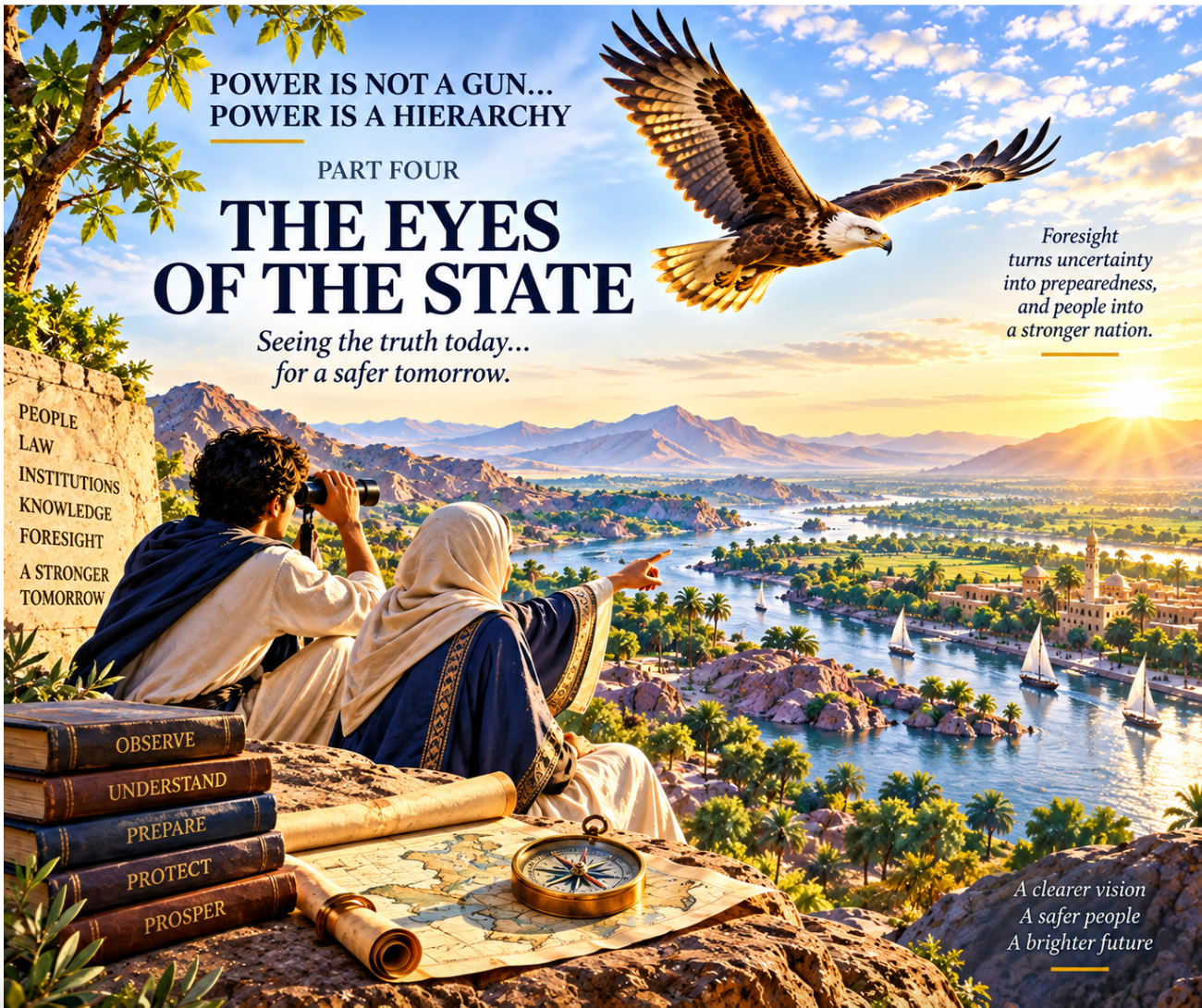
That evening, the Sudanese Eagle soared above the valley.
Waad watched it.
“Its wings carry it.”
“Yes,” said Ahd.
“And its talons protect it when they are needed.”
“Yes.”
“Then where is the strength in its eyes?”
Ahd asked: “How does it know where to fly?”
Waad looked up. “With its eyes.”
“And how does it see danger before the danger reaches it?”
Waad thought for a moment. Then he understood.
“The eyes do not carry the eagle… but they help it not to become blind in sight and foresight.”
Ahd smiled.
“What, then, are the eyes of our State?” Waad asked.
Ahd replied:
“The mirror of truth — and the foresight of the State.”
She pointed towards the land.
“One eye looks inward.”
Then towards the horizon.
“The other looks outward.”
“What are they looking for?”
“The truth first.”
Then she added:
“Danger before it becomes disaster… and opportunity before it passes.”
Waad looked again at the eagle.
“So a strong State does not wait for danger to reach its talons.”
Ahd shook her head.
“Foresight sees before strength is forced to confront.”
Waad remained silent for a while. Then another question came to him.
“If the eyes can see the truth… who decides what we should do with it?”
This time, Ahd did not answer.
The eyes can see. But seeing alone cannot make a decision.
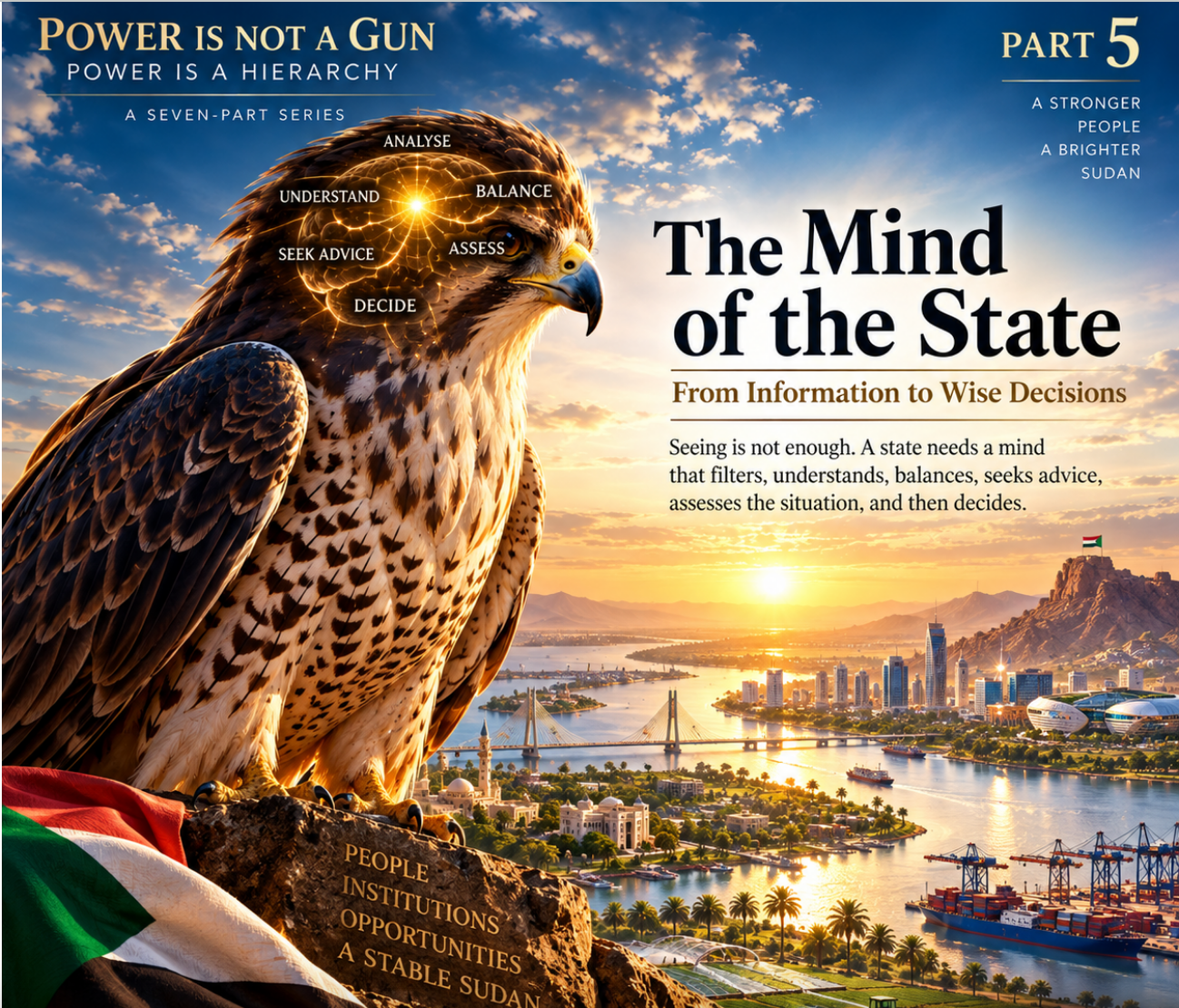
PART FIVE
THE MIND OF THE STATE