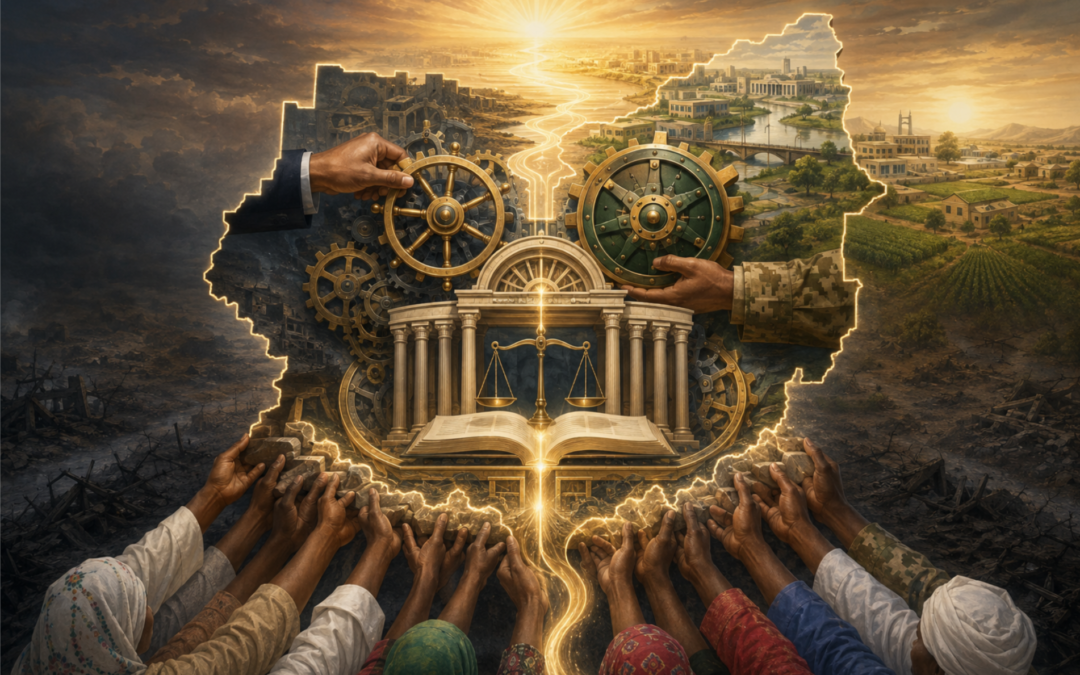
Who is legally entitled to drive, who determines the destination, and what prevents either the uniform or the suit from taking ownership of the vehicle?The State is the vehicle. The Constitution controls the steering. The people provide the power.
Could the solution for the great Sudanese people be consolidated into one governing concept?
Imagine Sudan as a vehicle representing the State and its institutions: the civilian in the suit occupies the driver’s seat, the military in uniform protects the journey, and the Sudanese people provide the fuel that moves the country from the devastation of war towards a brighter future.
The proposal is a “Three-in-One” model founded upon strong State institutions, accountable civilian government and unified professional armed forces. It is not three competing centres of power. It is one State in which three essential components perform separate but coordinated constitutional functions.
Beyond the Uniform and the Suit
Sudan’s political debate has too often been reduced to a choice between military and civilian government. That is a false and damaging choice. A government does not become effective merely because its ministers wear suits. Civilian government may still fail through corruption, fragmentation, patronage or administrative incompetence.
Equally, military government cannot acquire permanent legitimacy by invoking discipline, stability or necessity. The possession of weapons may create power, but it does not create a constitutional mandate to govern.
|
The true question is this: how can Sudan establish a constitutional State in which civilians govern competently, the armed forces defend professionally, and public institutions remain stronger than both? |
The State Is the Vehicle
Sudan must first rebuild the State—not merely form another government. Governments change, political coalitions collapse and commanders depart. The judiciary, civil service, police, prosecution authorities, land registries, central bank and local government must endure.
Post-war reconstruction must therefore be anchored in constitutional supremacy, judicial independence, separation of powers, transparent public finance, fundamental rights and peaceful transfers of authority. The African Union’s post-conflict framework similarly treats governance, security and development as connected elements of sustainable recovery. African Union Post-Conflict Reconstruction and Development Framework
The Civilian Must Drive
In the permanent constitutional order, civilian government must occupy the driver’s seat—not because every civilian is more capable than every soldier, but because government must rest upon public consent, legal accountability and the people’s right to remove their leaders peacefully.
Civilian supremacy must be real, not ceremonial. Civilian leaders require both the authority and competence to govern, while remaining answerable to the legislature, the courts, independent oversight bodies and ultimately the electorate.
The Military Must Protect the Journey
Sudan cannot achieve stable government while several armed organisations exercise competing political, territorial or economic authority. The settlement must establish one national military structure, with armed formations disarmed, demobilised, lawfully integrated or excluded according to objective standards and individual accountability.
Military service is a national responsibility—not an independent title to political power. The armed forces may contribute engineering, logistics and emergency capability during reconstruction, but participation cannot become ownership. The African Union’s security-sector framework likewise emphasises national ownership, democratic control and institutional oversight. African Union Policy Framework on Security Sector Reform
The Constitution Must Control the Steering
Sudan’s instability cannot be cured by permitting civilians and the military to exchange the driver’s seat whenever one considers the other incapable. The Constitution—not force, political convenience or an informal elite bargain—must determine who governs.
Any exceptional military role during an immediate post-war emergency must be legally defined, strictly limited, transparent, judicially reviewable and governed by a fixed timetable leading to representative civilian government.
|
CIVILIANS GOVERN Public policy through consent and accountability |
THE MILITARY PROTECTS National defence within constitutional limits |
INSTITUTIONS ENDURE Independent law, administration and oversight |
One State Under One Law
The vehicle belongs to the Sudanese people. The Constitution supplies its controls. Civilian government determines the lawful direction. The armed forces protect the journey. National institutions ensure that neither the uniform nor the suit stands above the law.
Most importantly, the Sudanese people are not passengers. They are the source of sovereignty and the energy without which the State cannot move.
Sudan does not need three rulers. It needs three coordinated national forces operating within one constitutional order: one State, one law and one people.
The destination must be more than the end of war. It must be a Sudan in which institutions prevail over personalities, law prevails over force and public office is understood not as ownership of the State, but as a temporary duty to serve it.

Contact Us
Disclaimer: Although you are invited to talk or contact us, we are unable to give legal advice in response to enquiries sent without acknowledged formal instructions and written confirmation from us. Please be informed that nothing on this website should be construed as legal advice.