A Legal Reflection on the Surrender of RSF Fighters and Their Possible Integration into the Sudanese Armed Forces
A legal and institutional perspective on surrender, accountability, reintegration and the role of lawyers in post-conflict decision-making
It is undoubtedly in Sudan’s national interest to see fighters from the Rapid Support Forces (RSF) abandon hostilities, surrender their weapons and place themselves under the authority of the State and the Sudanese Armed Forces.
Every weapon laid down, and every fighter who chooses to leave the battlefield, may bring Sudan one step closer to ending the cycle of violence and restoring the authority of the State.
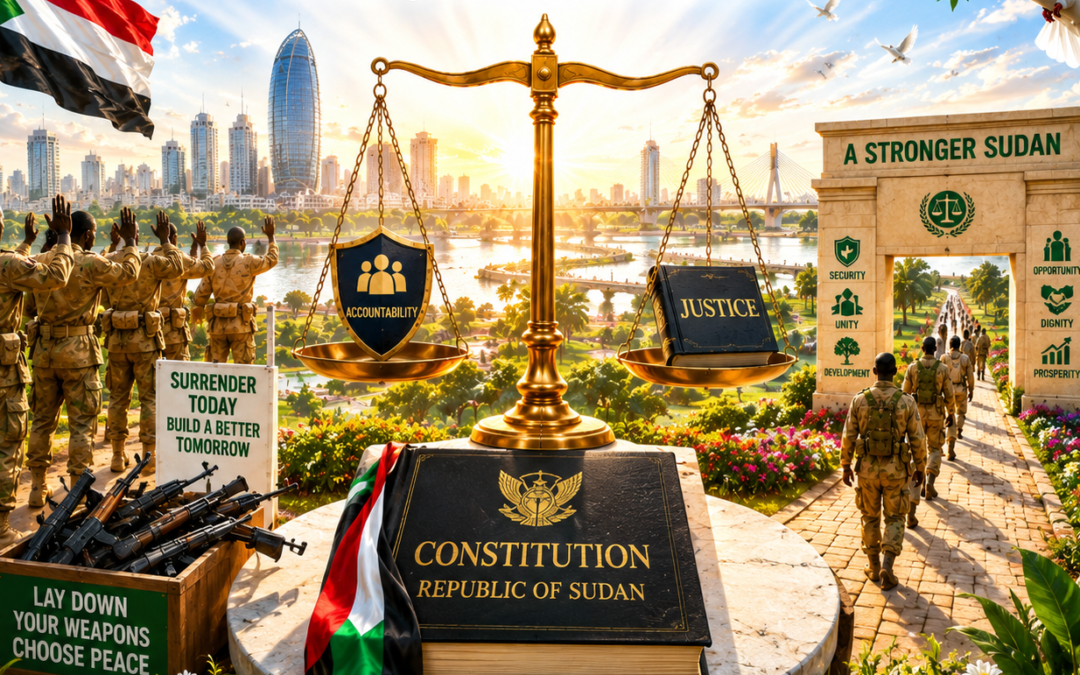
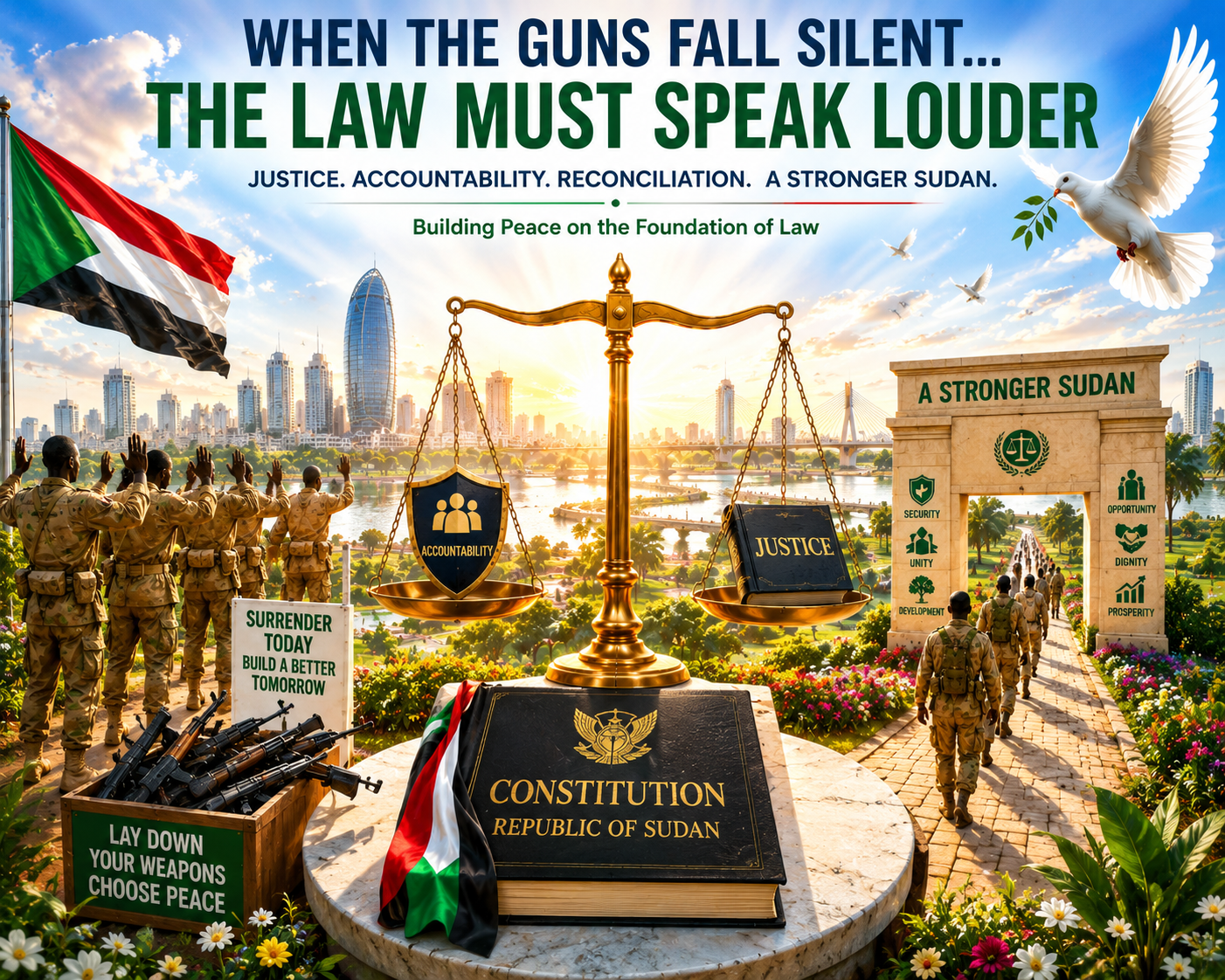
But it is precisely when the guns fall silent that the law must speak louder.
The question is not simply what should happen to those who surrender. The more difficult question is: does surrender create a right to become a member of the Sudanese Armed Forces?
As a matter of law, it does not.
Surrender, criminal accountability, civilian reintegration and recruitment into the national armed forces are four legally distinct matters. They should not be collapsed into a single political or military decision.
International law protects those who surrender — it does not give them a right to join the army
International humanitarian law is clear about the protection afforded to a fighter who genuinely surrenders.
A person who clearly expresses an intention to surrender, refrains from hostile acts and does not attempt to escape is regarded as hors de combat and must not be made the object of attack.
This is not merely a moral principle. It is a well-established rule of international humanitarian law, reflected in treaty law and recognised by the International Committee of the Red Cross as part of customary international humanitarian law applicable in both international and non-international armed conflicts.
International law protects the surrendering fighter from unlawful attack; it does not confer upon him a right to carry the weapons of the State.
That distinction is fundamental.
Surrender is not an application for military service
The Sudanese Armed Forces are not simply an alternative destination for those who carried arms yesterday.
A national army is an institution of the State. Entry into it must be governed by law, professional standards, security screening, discipline, training and the institutional requirements of the Armed Forces themselves.
The surrender of a weapon cannot, by itself, create a vested right to military integration. Nor should a rank previously held within the RSF automatically follow its holder into the Sudanese Armed Forces.
Military rank is not personal property. It is a legal and institutional status exercised within a particular command structure.
International post-conflict practice therefore recognises processes of vetting and rank harmonisation where former combatants are considered for integration into national security institutions.
The proper question is not simply what rank a person held in the RSF, but whether that individual is legally, professionally and institutionally suitable to serve in the national Armed Forces — and, if so, in what capacity and at what rank.
Not every person who surrenders is a criminal — and not everyone who surrenders is suitable to become a soldier
The law must be fair in both directions.
Membership of an armed formation should not, without more, lead automatically to an assumption of individual criminal guilt. Equally, surrender cannot operate as a legal eraser.
Where credible evidence exists that an individual may have participated in the killing of civilians, torture, rape, pillage or other serious crimes, surrendering a weapon or changing uniform cannot extinguish individual criminal responsibility.
Surrender may end a fighter’s participation in hostilities. It does not end the reach of justice.
This is precisely why international standards concerning Disarmament, Demobilisation and Reintegration (DDR) and Security Sector Reform (SSR) emphasise proper vetting, including consideration of past conduct and serious human rights violations, before former combatants are admitted into State security institutions.
Leaving the battlefield does not necessarily mean returning to another uniform
One assumption deserves particular scrutiny: that the solution for former fighters is necessarily to absorb them into the Armed Forces. It is not.
International post-conflict practice has long recognised another route: Disarmament – Demobilisation – Reintegration (DDR).
A former fighter may surrender his weapon, undergo the necessary legal and security screening, receive rehabilitation and vocational support, and return to civilian society.
That may serve Sudan far better than simply transferring large numbers of former combatants from one armed structure into another.
Reintegration into the State does not necessarily mean reintegration into the military.
Sudan must first restore the former fighter to citizenship before assuming that he should be restored to arms.
Integrate individuals — not armed structures
There may, of course, be individuals among those who surrender whose skills, experience and qualifications could legitimately be required by the Sudanese Armed Forces. The law need not prevent their future service.
But any such process should be individual, conditional, transparent and professionally regulated.
The danger lies in wholesale integration that carries into the national army the former force’s command structures, ranks, internal loyalties and organisational networks.
At that point, the State may no longer be integrating individuals into its army. It may instead be importing one army into another.
Sudan has already paid an extraordinary price for the existence of competing centres of armed power. It must therefore be careful not to emerge from a war caused, in part, by military fragmentation only to reproduce that fragmentation inside the national Armed Forces under the language of “integration”.
When the guns fall silent, lawyers must be at the table
There is, finally, a wider lesson for Sudan’s political and military leadership.
The treatment of surrendering fighters cannot safely be regarded as an exclusively military question to which lawyers are invited only afterwards to formalise decisions already taken.
The decisions made today may determine tomorrow’s questions of military status, criminal liability, rank, pensions, command structures, security vetting, citizenship rights, transitional justice and the future constitutional architecture of Sudan’s security institutions.
Those consequences are legal from the outset.
The role of lawyers must therefore begin when policy is being designed — not when documents are being drafted to implement it.
Military commanders understandably determine how weapons are surrendered and how immediate security is maintained. Political leaders determine the broader direction of the State. But lawyers must help determine the lawful architecture through which surrender, accountability, rehabilitation and any eventual military integration take place.
That is not legal interference in military affairs. It is the difference between an immediate battlefield solution and a sustainable institution of State.
Sudan should encourage every fighter genuinely wishing to abandon hostilities to lay down his arms. Those who surrender must be treated according to law and protected from collective punishment.
But what follows must depend upon the individual. Those against whom there is no case may return to civilian society. Those who satisfy the legal and professional requirements for military service may, following proper vetting and training, be considered individually for service in the Sudanese Armed Forces. Those against whom credible evidence of serious crimes exists must face the appropriate processes of justice.
And the Armed Forces themselves must remain a single national institution into which individuals enter according to law — not an institution into which armed formations enter carrying their old command structures, ranks and loyalties with them.
A wise State should open the door back to the nation for those who genuinely lay down their weapons. But surrendering yesterday’s rifle should never, by itself, create an entitlement to carry the State’s rifle tomorrow.
When the guns fall silent, the law must speak louder — and those who understand the law must already be at the table.
Selected Legal and Policy References
International Committee of the Red Cross, Customary IHL Database, Rule 47: Attacks against Persons Hors de Combat
https://ihl-databases.icrc.org/en/customary-ihl/v1/rule47
United Nations, Integrated Disarmament, Demobilization and Reintegration Standards (IDDRS)
https://www.unddr.org/the-iddrs/
Contact Us
Disclaimer: Although you are invited to talk or contact us, we are unable to give legal advice in response to enquiries sent without acknowledged formal instructions and written confirmation from us. Please be informed that nothing on this website should be construed as legal advice.