Strengthening Sudan’s Land Directorates to Protect the Nation’s Land
Sudan’s Land Directorates are entrusted with one of the State’s most fundamental responsibilities: protecting and administering the legal record of rights in land.
If the Land Directorates protect our rights in land, the question should therefore not simply be who protects them, but something more constructive: How do we protect the protector?
The answer lies principally in the institution itself. We protect the Land Directorates by continuously strengthening their capability, competence, integrity and performance until they provide Sudan with a land-administration system capable of meeting the demands of a modern State and progressing towards the highest recognised international standards.
Why It Matters
Land is where life begins. It carries water, supports agriculture, contains natural resources and provides the physical space upon which we build our homes, businesses and communities.
Land gives us home; home gives us security; and security creates the conditions for stability.
Every person needs a place from which to begin the pursuit of life and a place to which to return. We leave our homes to work, study, trade and contribute to society, and we return seeking safety, rest and peace. Land is therefore both our point of departure and our place of return.
The institution entrusted with protecting rights in that land cannot consequently be regarded as merely another administrative department. The Land Directorate is an institution of national stability. Behind a registered parcel may stand a family’s home; behind a title, an inheritance; and behind a recorded interest, a farmer’s livelihood, a company’s investment, a bank’s security or a citizen’s principal asset.
The Land Directorate is therefore not simply a custodian of maps, files and certificates. It is a custodian of legal certainty.
Protecting Through Improvement
The first principle should be continuous institutional development. The Land Directorates should never be permitted to become institutions that merely preserve yesterday’s records using yesterday’s methods.
Their legal framework must remain effective; their personnel professionally trained; their procedures faster, clearer and more transparent; their cadastral and ownership information accurate; their records securely preserved; and their performance measurable. Protection, in other words, should be achieved through capability.
Technology Must Serve the Law
Digital transformation should form an important part of this development, but Sudan should resist equating digitisation with reform. Scanning an inaccurate record does not make it accurate, and entering a disputed title into a database does not resolve the dispute. Technology is valuable only when the legal and institutional foundations beneath it are reliable.
“Ownership must survive the document that proves it, and the Registry must survive the building that houses it.”
The conflict that erupted on 15 April 2023 has given this principle particular significance. Buildings can become inaccessible, paper records can be lost and populations displaced, but legitimate ownership should not disappear with them. Sudan should therefore work progressively towards secure digital records, traceable changes, effective cybersecurity and geographically separated backup arrangements.
Learning Internationally, Building Sudanese
Sudan does not need to copy another country’s land-registration system. It needs to build a better Sudanese one. Its land system must reflect Sudanese law, customary interests, agricultural land, communal rights, inheritance and the particular challenges created by displacement and conflict.
But being Sudanese should never mean lowering the level of ambition. Sudan can study mature systems such as HM Land Registry in England and Wales and learn from international developments in cadastral mapping, digital registration, data security, fraud prevention and customer service.
The objective should be clear: a Sudanese Land Directorate operating according to Sudanese law, but performing to internationally respected standards.
Serving the Country, Not Merely Registering Land
A reliable registration system gives citizens confidence in ownership, assists courts in resolving disputes, makes property transactions safer, supports mortgage lending and access to finance, assists urban planning, infrastructure development and taxation, and gives investors greater confidence that legally acquired property rights can be identified and protected.
Land registration is therefore legal infrastructure, economic infrastructure and part of Sudan’s wider institutional development.
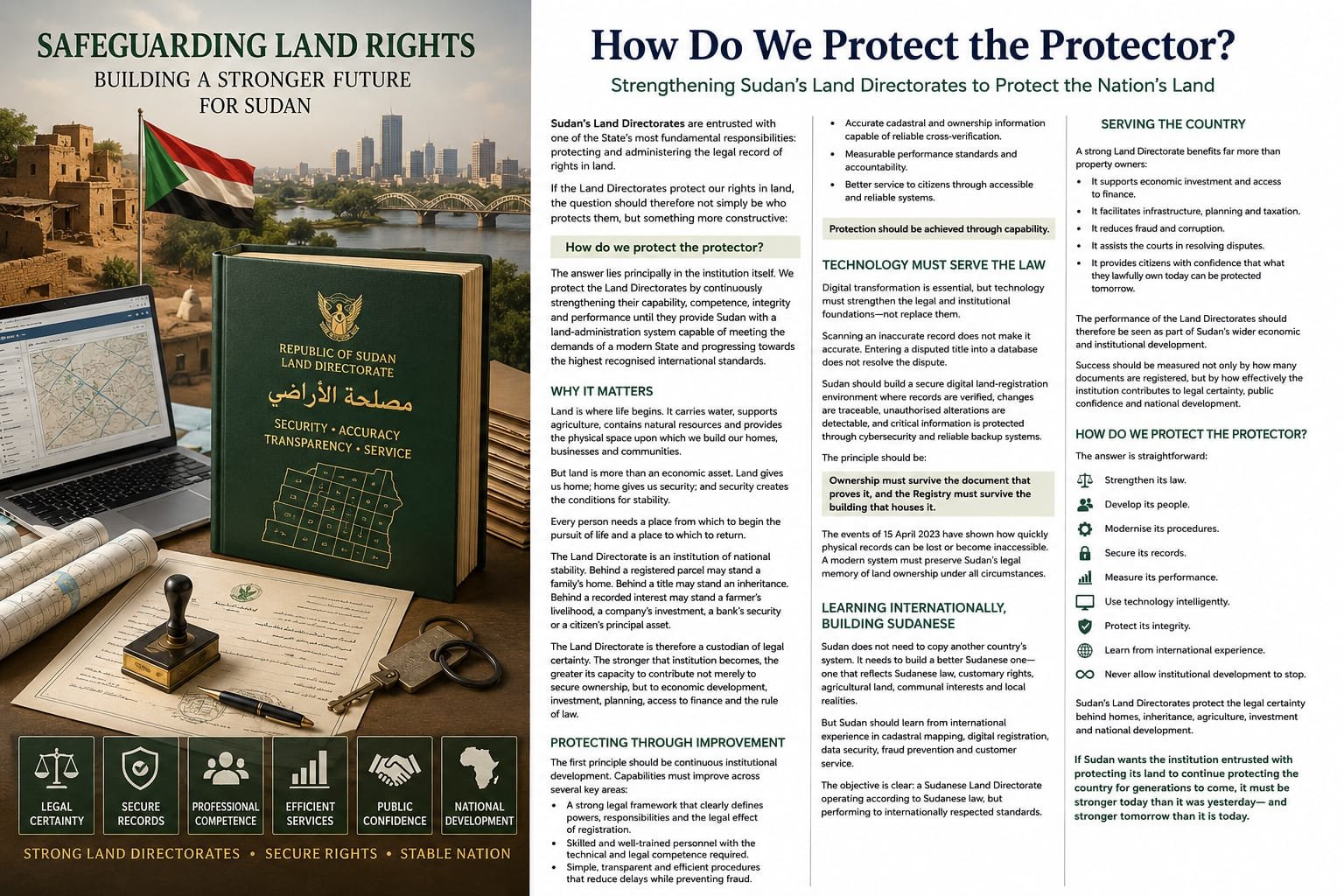
How Do We Protect the Protector?
- Strengthen its law.
- Develop its people.
- Modernise its procedures.
- Secure its records.
- Measure its performance.
- Use technology intelligently.
- Protect its integrity.
- Learn from international experience.
- Never allow institutional development to stop.
This should become a continuing national programme rather than a temporary modernisation exercise. Sudan’s Land Directorates protect considerably more than land records: they protect the legal certainty behind homes, inheritance, agriculture, investment and development.
We make the institution stronger today than it was yesterday — and ensure that it is stronger tomorrow than it is today.
Contact Us
Disclaimer: Although you are invited to talk or contact us, we are unable to give legal advice in response to enquiries sent without acknowledged formal instructions and written confirmation from us. Please be informed that nothing on this website should be construed as legal advice.