
Empowering Legal Professionals. Defending Human Rights.Restoring Hope for War Victims.
Sudan’s National Economy: The Tangible and Intangible Value of Legal Services
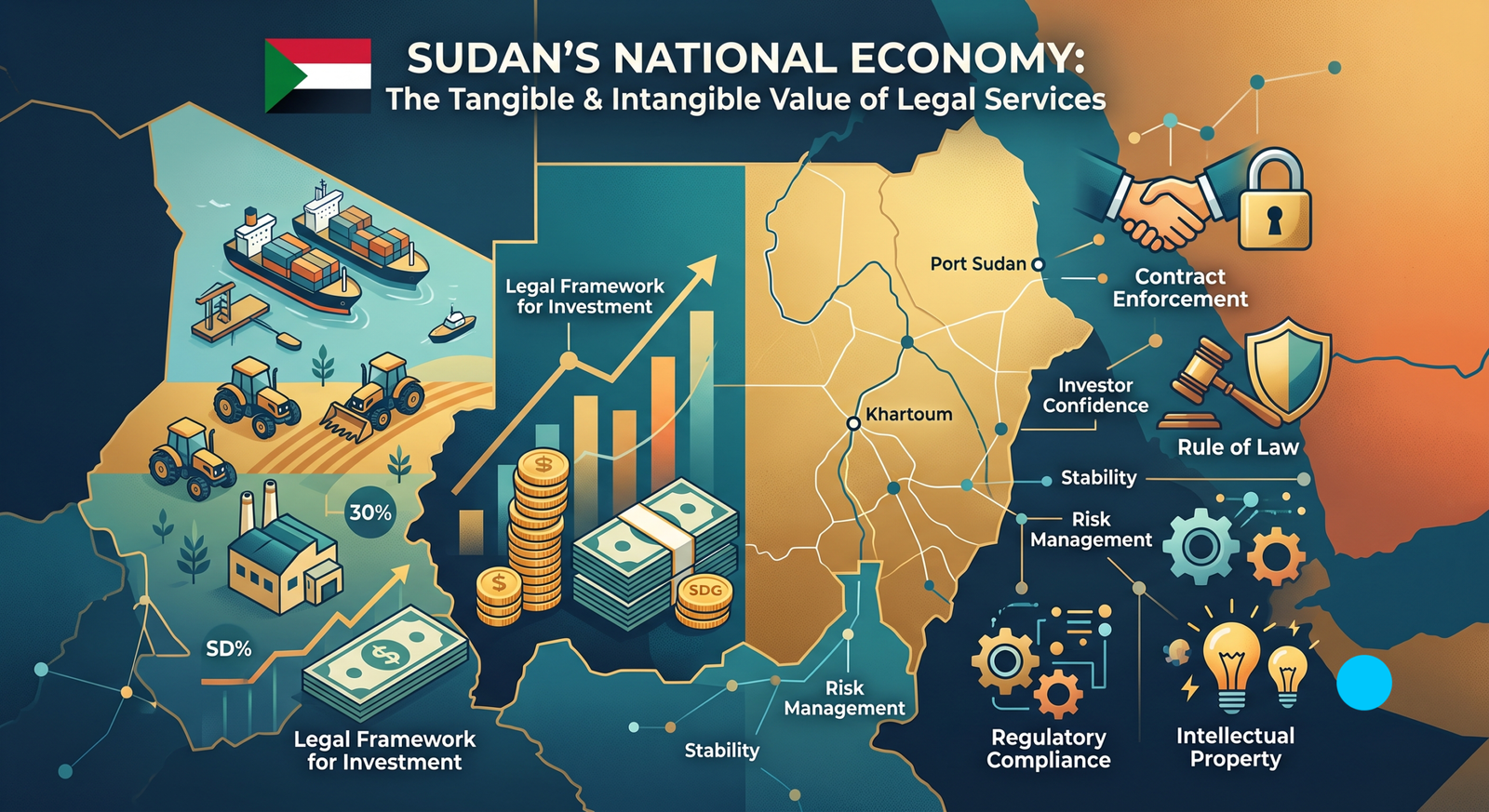
A national economy rests upon both tangible and intangible foundations. At its core, economic activity is generated through the production, sale and delivery of goods and services. While the economic contribution of physical goods is generally visible and readily measurable, the value created by professional services is often less apparent, despite being equally significant.
Among these professional sectors, legal services occupy a particularly important position. A strong and accessible legal-services market does more than generate income for legal practitioners. It supports commercial activity, protects property and contractual rights, facilitates investment, resolves disputes and strengthens confidence in public and private institutions.
Experience in developed economies demonstrates that legal services can make a substantial contribution to national economic growth. The sector supports businesses and individuals in navigating regulatory requirements, structuring transactions, managing risk and enforcing legal rights. It also creates employment and enables domestic and international trade to operate within a predictable legal framework.
Goods and services are therefore not competing components of the economy; they are complementary pillars of a nation’s Gross Domestic Product. Together, they sustain industry, facilitate commerce, create employment opportunities and promote long-term economic development. Without effective professional services—including legal, financial and regulatory services—the movement of goods, capital and investment becomes increasingly difficult and uncertain.
The Impact of Conflict on Sudan’s Economy
Sudan’s continuing armed conflict and political instability have caused profound harm to the national economy. Productive sectors have been disrupted, businesses displaced or destroyed, public institutions weakened and domestic and foreign investment severely affected.
The consequences extend beyond the physical destruction of infrastructure and commercial assets. Conflict also damages the intangible foundations upon which economic activity depends: legal certainty, institutional stability, public confidence, contractual enforcement and respect for the rule of law.
Where investors and businesses cannot rely upon the protection of property, the enforcement of agreements or the impartial resolution of disputes, economic confidence deteriorates. Restoring Sudan’s economy will therefore require more than rebuilding roads, factories and markets. It will also require the restoration of effective legal institutions and professional services capable of supporting a stable, transparent and accountable economic environment.
The Strategic Role of the Sudanese Bar Association
Against this background, the Sudanese Bar Association has the potential to play a meaningful role in Sudan’s economic recovery and future development. As a professional institution representing the legal sector, it is well placed to promote the value of legal services and incorporate their development into its short-, medium- and long-term strategic plans.
The Bar Association could contribute by supporting professional training, encouraging specialization in commercial and investment law, promoting ethical and professional standards, facilitating access to legal services and strengthening cooperation between Sudanese lawyers and their international counterparts.
It could also help develop legal services relating to corporate governance, banking, taxation, infrastructure, international trade, investment protection, arbitration and alternative dispute resolution. These areas will be essential to rebuilding commercial confidence and attracting responsible domestic and international investment.
Promoting Sudanese legal expertise internationally could further create professional opportunities, generate income and position Sudan’s legal sector as an active participant in cross-border commerce and post-conflict reconstruction.
Legal Services as an Instrument of Economic Recovery
A functioning legal-services sector is not merely a consequence of economic development; it is one of its principal enablers. Lawyers and legal institutions help businesses operate lawfully, protect investments, resolve disputes and establish the certainty required for sustainable commercial activity.
Accordingly, any credible strategy for Sudan’s economic recovery should recognise legal services as an essential component of national development. Revitalising this sector would strengthen the rule of law, support entrepreneurship, facilitate investment and contribute to rebuilding trust in Sudan’s institutions.
The Sudanese Bar Association, working alongside government institutions, universities, civil-society organisations, the private sector and international partners, can help place legal services at the centre of the country’s economic-recovery agenda.
Sudan’s future prosperity will depend not only upon rebuilding its tangible assets, but also upon restoring the intangible foundations of justice, legal certainty and institutional confidence. By strengthening and promoting the legal-services sector, Sudan can create a more secure environment for commerce, investment and sustainable national development.
Contact Us
Disclaimer: Although you are invited to talk or contact us, we are unable to give legal advice in response to enquiries sent without acknowledged formal instructions and written confirmation from us. Please be informed that nothing on this website should be construed as legal advice.